
A few days back, Atul Ganatra, president of the Cotton Association of India, presented a grim scenario of the crop's prospects in the 2024-25 season that starts in October. Addressing the association's annual general meeting, Ganatra said the area under the crop could go down by at least 10 per cent in the coming season due to falling yields and realisation, leading to farmers losing interest. The fear of a decline in acreage comes against the backdrop of India's cotton production probably falling to its lowest in a decade, according to estimates.

The global COVID-19 situation, rollout of vaccines, geopolitical trends, Union Budget and economic recovery would be the major factors driving investor sentiments in 2021 after a tumultuous year which saw both 'the worst of times and the best of times' for the stock market, said analysts. What a year 2020 turned out to be! From witnessing gigantic losses to record-shattering gains, investors went on a roller-coaster ride amid the coronavirus pandemic and massive stimulus measures. Markets closed 2020 with remarkable gains of around 16 per cent, but will the winning ways continue in 2021 as well?

Market benchmarks gave up intra-day gains to close in the red for the sixth session on the trot on Friday, capping a bruising week which saw a massive dash for safety amid rate hikes by global central banks and fears of slowing growth.

Benchmark equity indices Sensex and Nifty on Tuesday spurted by over 2.5 per cent to log their best single-day gains in three months, propelled by heavy buying in metal, energy and banking stocks amid a global rally in stocks. The 30-share BSE benchmark zoomed 1,344.63 points or 2.54 per cent to settle at 54,318.47 points with all of its constituents closing with gains. During the day, it jumped 1,425.58 points or 2.69 per cent to 54,399.42. The broader NSE Nifty rallied 417 points or 2.63 per cent to finish at 16,259.30 points.

Modi will arrive in New York on June 20 and will lead the 9th International Yoga Day celebrations at the UN headquarters on June 21.

Small stocks of Dalal Street grappled with turbulent times in 2022 as high volatility and higher interest rate regime sapped investors' appetite for these scrips but the horizon ahead seems less cloudy for the New Year. While the 30-share Sensex scaled multiple record peaks with bluechips glittering, small stocks underperformed and the BSE smallcap index declined more than 3 per cent this year. In comparison, the BSE Sensex climbed 2,673.61 points or 4.58 per cent till December 27.

Equity indices gave up early gains to close in the red for the third session on the trot on Wednesday, weighed by selling in banking and finance counters amid inflationary pressures and persistent foreign fund outflows. A weak rupee and lacklustre global cues also kept buying sentiment in check, traders said. The 30-share BSE Sensex opened on a firm footing but failed to hold on the momentum, finishing 237.44 points or 0.41 per cent lower at 58,338.93. On similar lines, the broader NSE Nifty dipped 54.65 points or 0.31 per cent to close at 17,475.65.

Several exchanges are facing a cash crunch with committed investment not coming from venture capital funds and trading activity seeing a sharp decline, reports Rajesh Bhayani.
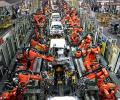
India's economy grew 6.1 per cent in the fourth quarter of 2022-23, pushing up the annual growth rate to 7.2 per cent, official data showed on Wednesday.

To select the right platform, get the opinions of a few existing users or browse online for feedback. Select a platform that offers a seamless experience. Check that the platform you are going with is a regulated entity, suggests Sanjay Kumar Singh.
The beleaguered Deutsche Bank announced major overhaul of its business, which included discontinuing loss-making equities trading business, creating a new 'bad bank', and cutting 18,000 jobs. Deutsche Equities India employs 35 people, all of whom could face the job axe.

Is self-reliance the right approach in a mega-buck game, or better to be part of a network? asks T N Ninan.

India must formulate a new growth path to become a top Asian economy.

'Building a whole product with the railways was challenging; we had to figure out how to load and unload a train when it stops for only about five minutes at a station.' 'We also helped them understand the revenues this would generate for them.'

But experts say downside limited, pockets of opportunities for investors

'12250 should be considered a reasonable level to re-enter into the market.'

Market participants are now awaiting Thursday's meeting of the European Central Bank

Benchmark stock indices Sensex and Nifty tumbled nearly 1 per cent on Wednesday due to profit booking in banking, financial and IT stocks after a recent rally. The 30-share BSE Sensex plunged 537.22 points or 0.94 per cent to end at 56,819.39 as 24 of its stocks declined. During the day, it tanked 772.57 points or 1.34 per cent to touch a low of 56,584.04. The broader NSE Nifty declined by 162.40 points or 0.94 per cent to 17,038.40 with 39 of its constituents ending in the red. Bajaj Finance was the biggest loser among Sensex stocks, dropping by 7.24 per cent.

Over the past week, the BSE Sensex ended on a muted note, showing a marginal gain of 2.25 points at 28,114.56.
As many as 40 staffers, in the key equities and investment banking division in India, could be asked to go as part of the London-headquartered lender's global layoffs, said people aware of the development. HSBC India declined to comment.

The current up move, according to analysts, closely resembles the rally post the global financial crisis in 2008-09, not just in quantum and speed, but also the way small-and mid-cap indices outperformed large-cap peers.

Although the first woman to hold the position of chief economist at IMF, it would be wrong to see her appointment through the lens of gender

'The pandemic had a significant impact on child trafficking.' 'With economic hardships, traffickers exploited the situation to target desperate parents and children.'

Equity investors grew richer by Rs 32.49 lakh crore in 2020 on the back of smart returns in the stock market which had a roller-coaster ride during the year hit by the coronavirus pandemic. The COVID-19 outbreak ravaged lives and livelihoods on a global scale, shuttering businesses and jolting world equities. But amid all the gloom, Indian stock indices gave hope of returning to winning ways towards the latter part of the year.
The government is expected to defer the mega initial public offering (IPO) of LIC to the next financial year as the ongoing Russia-Ukraine war has dampened fund managers' interest in the public issue, market experts said on Sunday. The government was looking to sell 5 per cent stake in Life Insurance Corporation (LIC) this month, which could have fetched over Rs 60,000 crore to the exchequer. The IPO would have helped meet the curtailed divestment target of Rs 78,000 crore this fiscal.

Had India agreed to join the trade pact, Indian markets would have been flooded with cheap Chinese products.

As if wanting to be an antidote to the coronavirus pandemic, the Indian stock market adorned carnival robes in 2021 with a tsunami of liquidity unleashed by global central banks coupled with supportive domestic policies and the world's largest vaccination drive sparking off a world-beating rally on Dalal Street, despite bouts of uneasiness over fizzy valuations. While the wider economy shuttled between recovery and relapse, dictated by multiple mutations of the virus, equity market benchmarks appeared headed in just one direction -- skywards. The dizzying upward journey has added a whopping Rs 72 lakh crore during 2021 to investors' wealth, measured as the cumulative value of all listed shares in the country, taking it to nearly Rs 260 lakh crore.

Yes Bank was the top loser in the Sensex pack cracking 6.51 per cent, followed by SBI, Axis Bank, Vedanta, Sun Pharma, ICICI Bank, IndusInd Bank, ITC, Infosys and Tech Mahindra, shedding up to 3.69 per cent.

RIL was the biggest gainer in the Sensex pack, rising 2.63 per cent, followed by NTPC, Axis Bank, Tata Steel, PowerGrid, HDFC twins, Bharti Airtel, M&M, ICICI Bank, SBI and Bajaj Finance -- gaining up to 2.51 per cent.

After two years of a record low interest-rate regime, Indian corporate houses are experiencing a sharp and abrupt increase in funding costs. With the Reserve Bank of India last month making an unequivocal turn towards policy tightening amid high inflation, firms looking to tap the capital markets for funds are ending up shelling out more. The yield on the benchmark triple-A-rated corporate bonds maturing in three years has climbed 98 basis points (bps) since the policy rate hike in May. It was last at 7.47 per cent, Bloomberg data showed.

India has received over USD 20 billion in FDI amid the coronavirus pandemic, Foreign Secretary Harsh Vardhan Shringla said on Tuesday, showcasing the country as one of the most attractive destinations for investment globally.
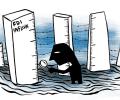
Foreign direct investments into the country is on the rise, jumping to $12.1 billion in May this year, Commerce and Industry Minister Piyush Goyal said on Monday. He also said the government is working on a mission mode to achieve exports target of $400 billion in 2021-22. "India has received the highest ever FDI inflow in 2020-21. "It surged by 10 per cent to $81.72 billion and FDI during May 2021 is $12.1 billion, i.e. 203 per cent higher than May 2020," he said while addressing a meeting of different industry associations on promoting exports.

The agreement provides for extensive cooperation in the civil nuclear energy sector including in research and development for peaceful uses of nuclear energy, they said.
'The world does not care about the tension on our border.' 'India has to emerge as a strong economic power.' 'Respect comes when the world sees a country with a direction and leadership that has a vision,' points out Ramesh Menon.

From its all-time peak of 38,989.65 scaled on August 29 this year, the Sensex has fallen by 2,921.32 points, or 7.5 per cent, to 36,068.33.

India will need to travel back in time and seek inspiration from football greats Tulsidas Balaram and Chuni Goswami to deftly dribble around and sidestep the West-imposed price cap on exports of Russian seaborne crude oil. India depends on imported oil to meet 86 per cent of its needs, of which nearly a quarter now comes from Russia. The copious flows are roughly 10 per cent cheaper than competing suppliers helping India save billions of dollars in fuel costs.

Infosys was the top gainer in the Sensex pack, rallying around 7 per cent, followed by TCS, IndusInd Bank, ONGC, HDFC Bank and HCL Tech. On the other hand, ITC, Bajaj Finance, Kotak Bank and Sun Pharma finished in the red.

Over the next three - six months, UBS believes earnings will be the main driver for EM equities outperformance.

Ahead of his India visit on February 24-25, Trump said that India has not treated his country 'very well' on the trade front and indicated that a 'very big' bilateral deal with New Delhi may not be signed before the American presidential election in November.

If a retail investor wants exposure to a healthcare ETF, it should be a part of his satellite portfolio, suggests Sanjay Kumar Singh.
